
Why standard-compliant cable lugs and certified tools matter?

A Small Component with a Major Safety Impact
Compliance, responsibility and reliability
Across Malaysia’s electrical installations, the humble crimped cable termination plays a far more critical role than many realise.
Additionally, Crimping tools ensure secure connections in factories, commercial buildings, infrastructure tunnels, and residential projects.
A cable lug may look simple, but the quality of its crimp determines whether a system runs efficiently for decades or becomes a hidden fire hazard waiting to ignite.
Indeed, many failure investigations across the region show that overheated or loose terminations are common causes of electrical breakdowns.
Additionally, these risks rise when installers use non-standard lugs or uncertified hand tools not meeting Malaysian safety rules.
Using proper Crimping tools that meet standards helps reduce these issues.
For electrical contractors, panel builders and electrical dealers, understanding proper crimping practices is no longer a matter of preference—it is a matter of compliance, responsibility, and long-term system reliability.
A Correct Crimp Makes the Lug Part of the Cable
Proper crimps deliver decades of reliable performance
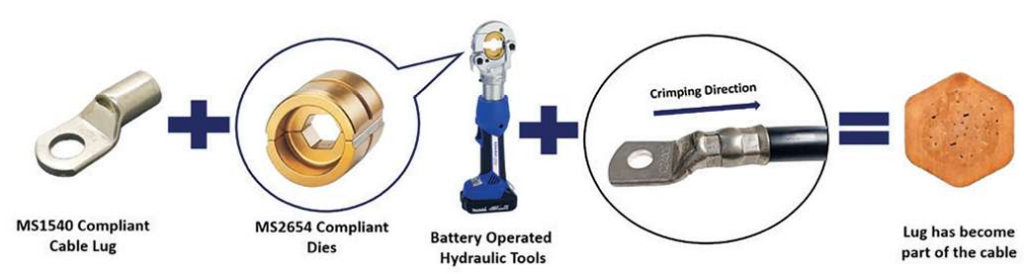
A properly executed crimp effectively forms a cold-weld bond between the conductor and the cable lug.
When the correct combination of lug, die, crimping tool and procedure is used, the copper strands compress uniformly into a compact mass, creating a joint that behaves as if the lug is simply and extension of the conductor.
This produces exceptionally low electrical resistance, allowing current to flow with minimal temperature rise and ensuring long-term stability even under continuous loading, vibration or thermal cycling.
Installations using correct crimping techniques routinely demonstrate service life spanning two to three decades without degradation.
The reliability of such joints reduces maintenance needs, improves operational efficiency and enhances the overall safety profile of any electrical system.
The Hidden Dangers of Incorrect Crimping
Poor crimps create costly, dangerous hotpsots
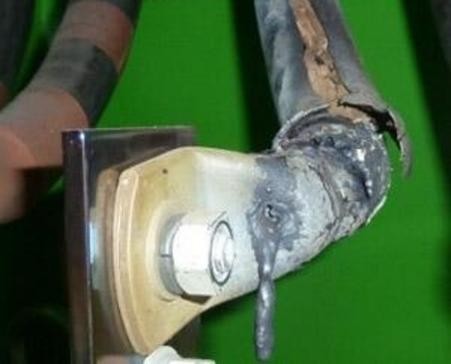
When a crimp is executed poorly—whether due to the wrong die, poor-quality lug or an insufficient compression stroke—the connection become vulnerable from the moment it is energised.
High resistance areas, commonly known as hot spots, begin developing at the interface between the conductor and the barrel. Over time, these hot spots can accelerate oxidation, weaken mechanical grip, and cause the joint to loosen under vibration or thermal expansion.
As the connection deteriorates, temperatures climb even further, significantly increasing the likelihood of equipment malfunction, cable damage or electrical fire.
Incomplete or uneven crimps also create microscopic air gaps inside the lug barrel. Moreover, these pockets of oxygen promote corrosion of the conductor strands, which further raises resistance and compounds the problem.
In large buildings containing hundreds or thousands of terminations, the cumulative energy loss caused by poor crimps becomes substantial, leading to higher operating costs and unnecessary heat build-up across the installation.
Why Malaysian Crimping Standards Exist
Ensuring safe, consistent and reliable crimps
Malaysian Standards were established to create a consistent, safe and repeatable method for producing high-quality electrical joints.
MS 1540 governs the manufacturing quality of copper lugs, ensuring that every lug meets strict criteria for material purity, dimensional accuracy, mechanical strength and copper hardness.
Lugs that do not comply with MS 1540 often have inconsistent barrel diameters, uneven wall thickness, inferior conductivity or copper that is too soft or too brittle—all of which result in unreliable crimps.
Similarly, MS 2654 regulates the performance of crimping dies and systems to ensure that conductor compression is uniform that that die alignment is correct.
The standard that ensures that the deformation of the strands meets repeatable measurable criteria that installers can trust, regardless of job site or cable brand.
Without these standards, the quality of electrical terminations would depends entirely on operator skill and tool variability, introducing unacceptable risk into electrical installations nationwide.
Matching Cable Classes with the Correct Crimping Profiles
Correct dies for reliable connections
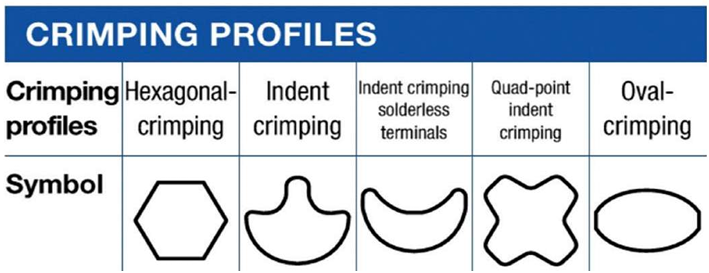
Different types of cables respond differently to compression, which is why the matching die profiles to cable class is so important.
Solid and Class 1 conductors, traditional Class 2 stranded cables, and flexible Class 5 or Class 6 conductors each require specific crimp geometries to ensure proper deformation.
When the wrong profile is sued, strands may break, deform unevenly or fail to compact tightly, resulting in a weak and unreliable electrical connection.
Correct pairing of dies, lugs and cables ensures that the conductor fills the barrel completely and forms and consistent low-resistance bond.
The Most Reliable Way to Achieve Standard Compliance
Hydraulic crimpers deliver results
Battery-powered hydraulic crimping tools have become the preferred solution for professional installers because they guarantee consistent compression every time.
Unlike manual hand tools, which vary greatly depending on operator strength and technique, hydraulic tools deliver controlled and predictable force throughout the entire crimp cycle. This ensures that each termination confirms to Malaysian Standards and manufacturer recommendations.
Modern hydraulic crimpers include advanced features such as one-button operation, automatic retraction upon completing a full compression, integrated LED lighting for dark or cramped environments, and ergonomic weight distribution to reduce operator fatigue.
These features minimise human error and prevent partially completed crimps—one of the most common causes of overheating and equipment failure.
Why Contractors Must Prioritise Crimping Quality
Certified tools protect and reassures
Contractors today operate in an environment where clients, consultants and insurers demand higher safety compliance and traceability.
Using no-standard lugs or uncertified crimping tools exposes contractors to costly rework, premature equipment failure, warranty disputes and, in the worst cases, legal liability.
Failed inspections can delay entire projects, and poor workmanship can severely damage a contractor’s reputation.
Investing in proper tools and certified components is not only a technical requirement but also a long-term business safeguard.
Why Dealers Benefit from Stocking Certified Tools and Lugs
Build trust and credibility
For electrical dealers and distributors, carrying certified MS 1540 compliant lugs and MS 2654 approved crimping dies offers a clear advantage.
Not only does it improve customer trust and reduce the risk of returns, but it also positions the dealer as a reliable technical partner rather than just a supplier of parts.
When contractors achieve consistent, problem-free installations using products supplied by the dealer, loyalty increases and so does repeat business.
Dealers who actively promote proper crimping practices help raise the safety standards of Malaysia’s electrical installations as a whole.
Improve Electrical Panel Production with Crimping Tools
Reliable terminations, superior quality
For manufacturers of switchboards, distribution boards and control panels, the quality and consistency of wire terminations directly influence product reliability, audit performance and customer confidence.
Traditional manual tools, though still commonly used, often product inconsistent crimps—especially during shift rotations or when workers rotate across shifts or work on high-volume production lines.
Electromechanical crimping and stripping tools, such as those developed by leading European manufacturers, offer panel builders a major competitive advantage.
These tools provide precise, repeatable and fully controlled stripping lengths, conductor preparations and crimp formations. Because electromechanical tools operate with consistent force and automatic cycle completion, they eliminate variations caused by operator fatigue or technique.
This ensures that every termination inside a panel meets the same high standard, reducing the likelihood of loose connections, overheating or premature failures once the board is energised.
Furthermore, the use of electromehcanical tools significantly improves production efficiency. Automated stripping and crimping reduce assembly time per panel, support higher throughput and help manufacturers meet tight delivery deadlines without compromising quality.
For ISO-certified manufacturers and those supplying to international customers, these tools also simplify compliance during factory audits and quality assurance checks.
In short, panel builders who adopt electromechanical stripping and crimping technologies achieve superior reliability, faster production, and a stronger reputation for engineering excellence.
Every Crimp Matters
In the world of electrical installations, a single termination often carries the same importance as a major piece of equipment. When a crimp is done right, it quietly performs its role for decades, ensuring safety, efficiency and uninterrupted operation. When it is done poorly, it becomes a point of vulnerability with potentially severe consequences.
By choosing MS 1540 compliant lugs, MS 2654 certified dies and modern hydraulic or electromechanical crimping tools, contractors, panel builders and dealers all contribute to safer, more reliable electrical systems across Malaysia.
Safety is priceless. And in electrical work, every crimp truly matters.
Click here to view the full article.